What Medieval Pageant Wagons Can Teach Modern Themed Entertainment
The audience stays. The actors stay. The world moves.
What if a theatre did not need to hide its scene changes? Instead of changing scenery behind curtains, lowering it from a fly tower or projecting another environment onto a screen, the next world simply rolled into the theatre?
A village arrives from one side. A fortress enters from the other. The actors continue the story while the village disappears. A bridge replaces it. Then a ship. Then a temple.
The stage never goes dark. The principal performers never leave the story. The scenery itself becomes part of the action. It sounds like an unusual theatrical concept. But part of the idea is more than six hundred years old.
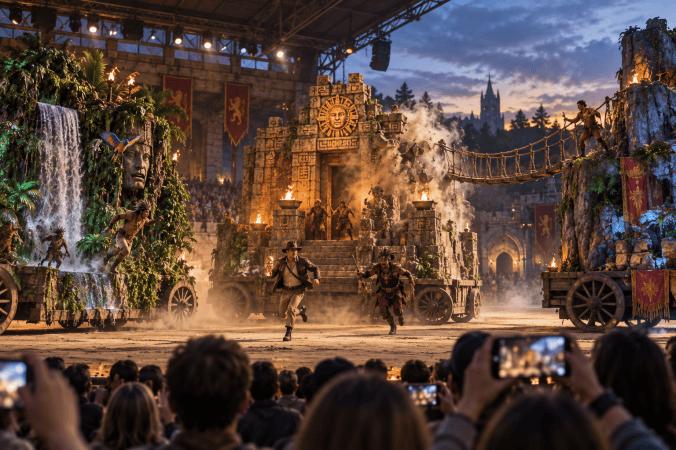
Parade Theatre in action – concept visualisation. Three scenic worlds can exist in the same moment: one leaving, one active and one arriving, while the performers continue the story in the central arena. Concept and visualisation: The Disentangler.
When the theatre came to the audience
By the late fourteenth century, medieval York was staging its famous Mystery Plays using pageant wagons: mobile theatrical stages that carried scenery, performers, costumes and sometimes surprisingly sophisticated theatrical machinery through the city.
The York Mystery Plays are documented by 1376, although the tradition was already established by then.
Different craft guilds were responsible for different episodes in the enormous biblical cycle.
The Shipwrights, appropriately enough, performed the building of Noah’s Ark.
Other guilds presented scenes ranging from Creation to the Crucifixion and the Last Judgement.
The surviving York cycle contains 48 individual plays. Historical accounts describe the performances moving through a series of designated playing stations around the city.
But what interests me most is not simply what they performed.
It is how the entire performance system worked.
Instead of constructing one theatre and bringing the audience towards it, York distributed the theatre throughout the city.
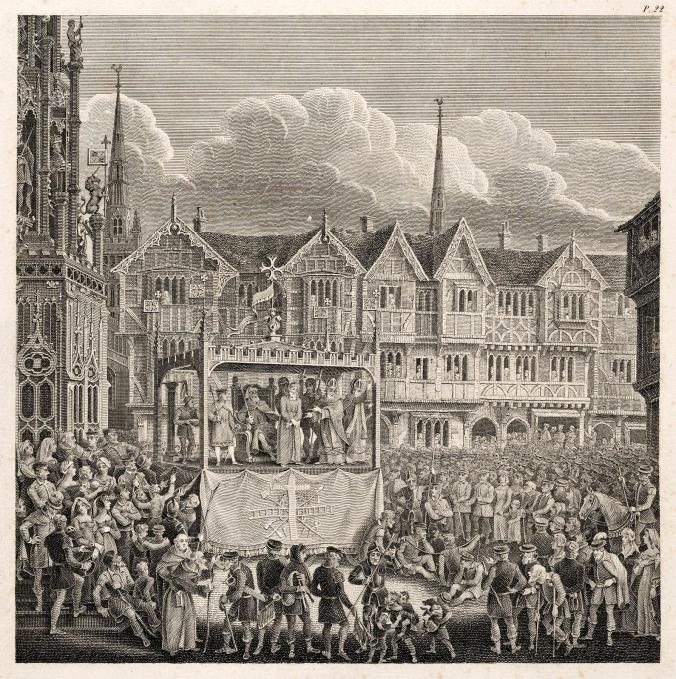
A nineteenth-century reconstruction of a medieval pageant vehicle. This engraving was created by David Gee in 1825 for Thomas Sharp’s study of the Coventry mystery plays and depicts Christ Before Pilate. It is not a surviving medieval illustration, but was reconstructed from historical descriptions and became an influential interpretation of pageant-wagon staging. Public domain.
A city operating as one enormous theatre
York normally used around twelve designated playing stations, but historical evidence indicates that the number could vary considerably.
At different moments there may have been approximately 10 to as many as 16 playing stations.
Sixteen separate audience locations.
For a theatrical system operating hundreds of years before radios, telephones, digital show control, motorised scenery or computer scheduling, the logistics are remarkable.
A pageant performed at Station 1.
Then the wagon, scenery and performers travelled to Station 2.
The next production moved into Station 1.
The first continued to Station 3.
Another arrived behind it.
As the day progressed, the complete cycle spread throughout York.
Eventually several different stories could be taking place at different locations around the city at the same time.
A spectator, however, did not necessarily have to follow them.
They could remain at one playing station.
One production arrived.
It performed.
It departed.
Another followed.
And eventually the whole sequence passed in front of them.
The audience could stay.
The theatre travelled.
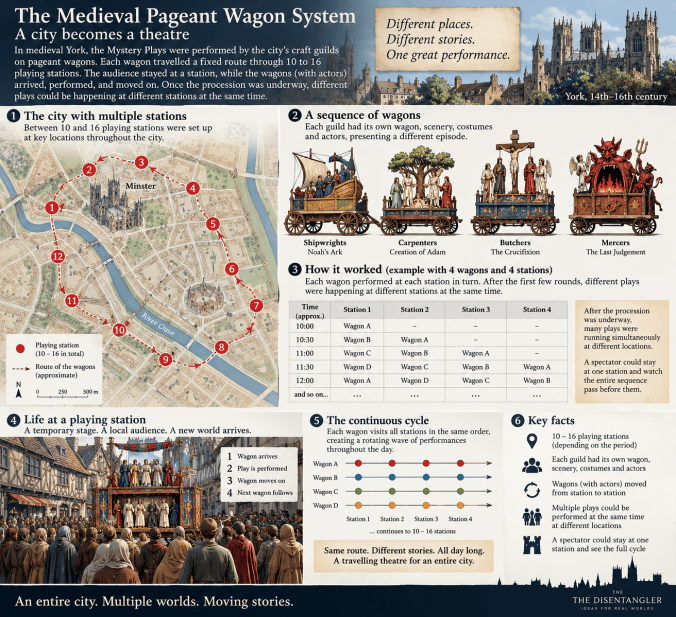
How the medieval pageant-wagon system worked. A wagon, its scenery and its performers moved from one playing station to the next. Once the procession was fully underway, several different plays could be performed simultaneously around the city. Interpretive schematic: The Disentangler. Route and station positions shown schematically and not intended as an exact historical map.
These were not necessarily primitive wooden carts
It is tempting to picture a medieval pageant wagon as little more than a farm cart with a few actors standing on top.
The surviving evidence suggests something considerably more interesting.
One particularly remarkable document is the 1433 inventory of the York Mercers’ Last Judgement pageant.
It gives us a glimpse of the theatrical equipment belonging to one of York’s most spectacular productions.
The inventory describes elements including:
- a four-wheeled wagon;
- painted cloths;
- stars;
- clouds;
- a wooden rainbow;
- angels;
- a representation of Heaven;
- a Hellmouth;
- and machinery associated with raising Christ.
We do not know exactly what this wagon looked like. Its dimensions, orientation and precise arrangement remain matters of reconstruction.
But there is enough evidence to understand the principle.
This was not merely transportation.
It was an integrated theatrical machine.
Vehicle + stage + scenery + effects + performance space.
In modern themed-entertainment terminology, I would almost call it:
Show engineering on wheels.
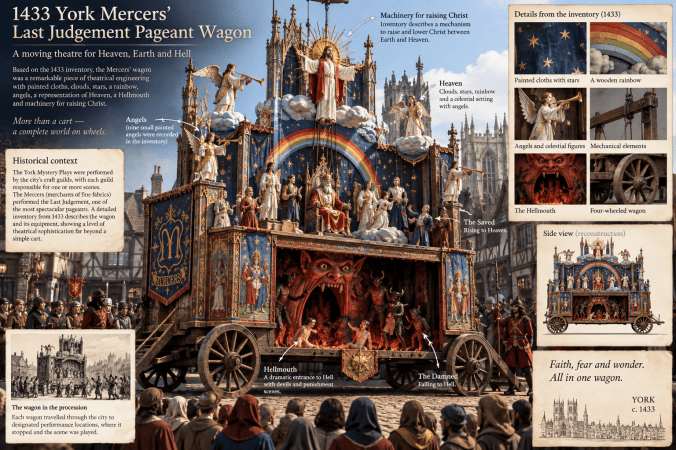
Interpretive reconstruction of the York Mercers’ Last Judgement pageant wagon, based on elements recorded in the 1433 inventory. The inventory documents extraordinary theatrical components including painted cloths, clouds, stars, a wooden rainbow, angels, Heaven and mechanical elements. The precise historical appearance and configuration of the wagon are unknown. Reconstruction and visualisation: The Disentangler.
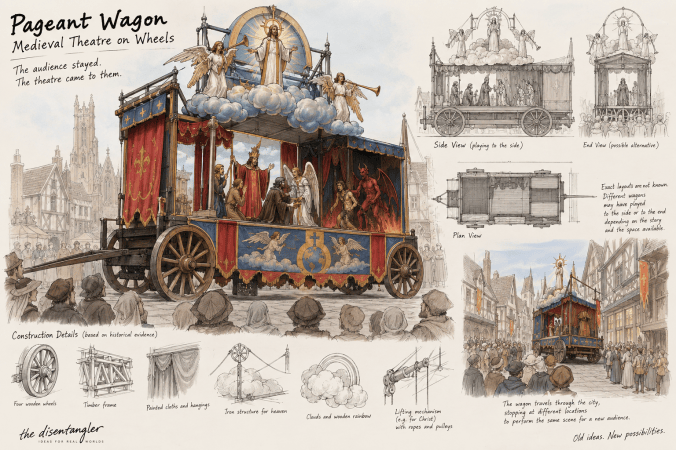
A design study exploring how a medieval pageant wagon might have combined transport, scenery and theatrical machinery. Exact wagon configurations are not known, and different pageants may have used different solutions. Interpretive concept study: The Disentangler.
The idea still works
Pageant-wagon theatre did not simply disappear into history.
Modern York still performs Mystery Plays using wagons.
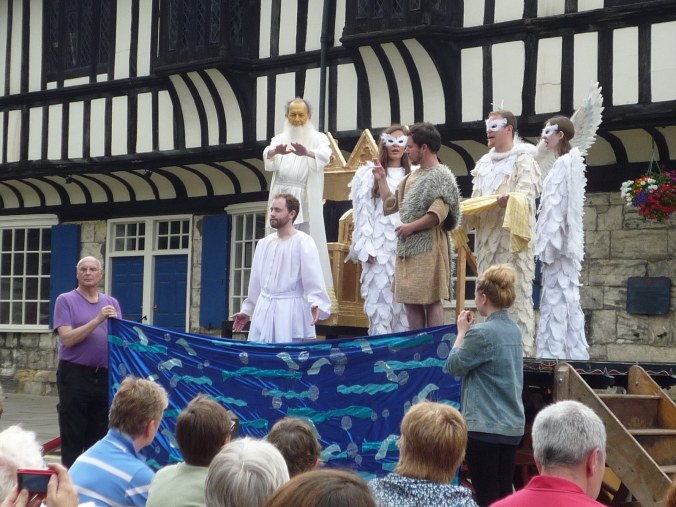
The Barbers’ Play: The Baptism, York Mystery Plays, 20 July 2014. A modern Mystery Play performed from a cart in the streets of York, with St William’s College in the background. Photo: Roger W. Haworth / Wikimedia Commons – CC BY-SA 4.0
The modern productions are especially interesting because different groups continue to interpret the wagon itself as part of the stage.
For the Crucifixion, for example, York uses a specially constructed wagon whose structure helps raise the cross. York describes the wagon itself as becoming the hill of Calvary.
That is precisely the principle that interests me:
The wagon is not only transportation.
The wagon performs.
The tradition still operates in the twenty-first century
In June and July 2026, York again presented ten plays on pageant wagons. They travelled between four performance locations: Minster Refectory Gardens, King’s Square, St Sampson’s Square and Dean’s Park. The principle was still recognisably medieval:
a wagon arrives, the actors perform, the wagon and company move on, and another follows.
More than six centuries later, the basic theatrical logic still works. But that creates another question.
If the system works, why should pageant-wagon thinking be restricted to historical performances?
Modern theme parks already use a distant relative
Look at a modern theme-park parade. A large scenic environment moves toward an audience. Performers inhabit it. Music, choreography and technical systems travel with it. Some parades go a step further and include show stops. At a predetermined location, the procession temporarily halts. Performers leave or interact around the floats. For several minutes, the parade becomes something closer to theatre.
The 2026 Disney Princess Cavalcade at Disney Adventure World is a good example: the procession includes an interactive midpoint where the Princess characters leave their floats and guests are invited into the choreography. Then the performers and floats continue travelling.
It remains fundamentally a parade.
What if we change one thing?
The medieval system can be simplified as:
Audience stays.
Actors move.
Scenery moves.
A parade works in much the same fundamental way.
The scenic environment and its performers travel together.
But what happens if we change just one element?
Audience stays.
Actors stay.
Scenery moves.
That creates a fundamentally different theatre.
I call the idea:
PARADE THEATRE
A theatre in which the story stays — and the scenery parades.
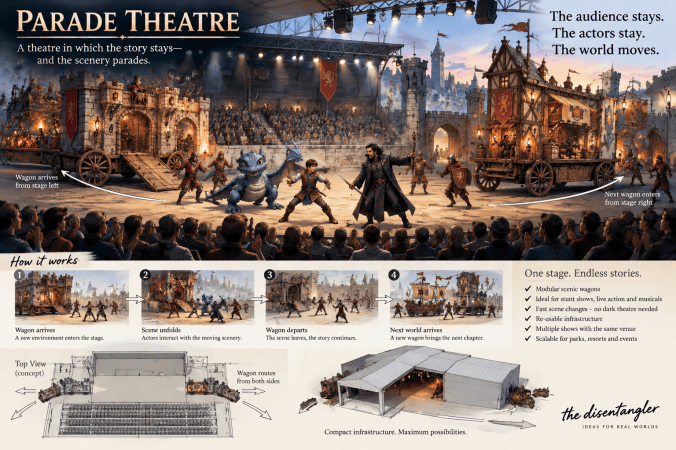
Parade Theatre – concept principle. The audience and principal performers remain in one central arena while modular scenic worlds enter from either side, become part of the continuing action and leave again. Concept and visualisation: The Disentangler.
Instead of changing scenery, bring in another world
Imagine a covered grandstand overlooking a large, relatively open performance arena.
The permanent theatre does not contain one enormous castle, pirate village or temple.
Instead, large scenic units can enter from both sides.
The story begins.
A village rolls into view.
The actors interact with it and continue the scene in the arena.
Then a fortress begins arriving from the opposite side.
The villain appears on its battlements.
The village departs.
But the principal performers do not disappear with it.
The story continues.
A bridge arrives.
The action transfers onto it.
The fortress departs.
Then perhaps a ship.
A jungle.
A temple.
A railway station.
A giant machine.
Every wagon brings another physical chapter of the same continuous story.
That creates the distinction I find most interesting:
Medieval pageant theatre moved the play from audience to audience.
Parade Theatre moves the world through the play.
The scene change becomes part of the show
Traditional theatre often attempts to hide scene changes… The curtain closes. The theatre goes dark. Performers distract the audience while scenery is replaced. Automation makes the transition as seamless as possible. Parade Theatre could do the opposite.
Don’t hide the change. Make it an event.
Something begins approaching from Stage Right. The actors notice it. The music changes. The audience turns. A huge fortress begins rolling into the arena. Someone is already fighting on its roof before it has even stopped moving. Meanwhile, the previous scenic environment is still departing from the other side. For several seconds the audience sees:
the previous world leaving,
the story continuing,
and the next world arriving.
The transition itself becomes part of the entertainment.
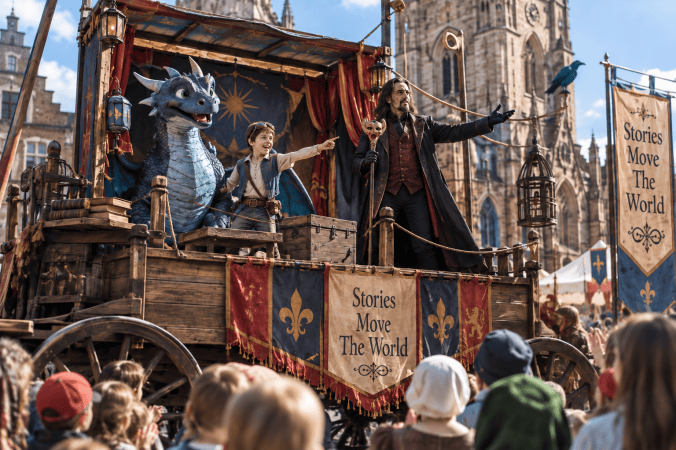
The scenery does not need to wait backstage. It can become an active participant in the story. A scenic wagon can carry characters, architecture, props and theatrical effects directly into the performance. Concept visualisation featuring Danil, Blue and Lucien – The Disentangler.
Pageant wagons become modern show machines
The word wagon sounds simple.
The engineering does not have to be.
A modern Parade Theatre scenic unit could contain:
- elevated stunt positions;
- breakaway doors and walls;
- high-fall platforms;
- performer entrances;
- concealed safety systems;
- lighting;
- sound;
- smoke and atmospheric effects;
- pyrotechnics;
- mechanical transformations;
- rigging;
- projection surfaces;
- show-control interfaces;
- practical water effects;
- storage for props;
- and automated moving elements.
A jungle unit could arrive with a functioning waterfall and mist. A temple could contain collapsing masonry and stunt platforms. A ship could bring its own deck, cannons, sails and lighting. A fantasy castle might conceal an entirely modern steel structure and automated show system. And because the audience can see the scenic units arriving, their mobility is not a problem that needs to be disguised. It becomes part of their identity.
Three worlds can exist in one moment
Imagine an adventure story set in Peru. A jungle environment is disappearing on the left side of the arena. Its waterfall is still running. Mist hangs between the vegetation. In the centre, an Inca-inspired temple remains active. Part of it is collapsing. Actors race down the steps. The adventurer has just escaped with a ceremonial object.
From the opposite side, the next scenic unit is already arriving. An Andean cliff. A rope bridge. Another performer waits above the arena. The adventurer does not stop. He runs from the disappearing temple toward the arriving mountain. The story never pauses while the scenery changes.
That is the potential of Parade Theatre.
A theatre platform instead of one permanent show
There is also a commercial reason to explore the idea. Large themed stunt shows can require enormous investments in permanent scenery. A venue may contain a complete harbour, village, castle, temple or other fixed environment. That can create a spectacular attraction. But it also ties a significant amount of infrastructure to one specific production. When that show eventually needs replacing, the attraction may require substantial reconstruction. Parade Theatre separates more of the venue from the show content. The permanent investment could concentrate on:
grandstand + arena + roof + backstage routes + lighting + audio + utilities + show control.
The spectacular scenic worlds become modular. That does not automatically make the production inexpensive. Large moving scenic units can require substantial engineering, maintenance, certification and safety systems. But it changes the investment model. Instead of building one complete permanent world, an attraction develops a library of theatrical worlds. Those worlds can potentially be modified or replaced individually.
One theatre. Multiple stories.
The same venue might present a medieval siege, a pirate adventure, an Inca expedition, a fantasy show, a Western, a science-fiction production, a Halloween show, or a Christmas spectacle. Some structural units might even be reused. A cliff can be redressed as a castle ruin. A bridge can become an industrial gantry. A village can become a harbour. A wagon built around a particular stunt mechanism can support different scenic treatments. That changes the theatre from a single attraction into something closer to a show platform.
Change the wagons.
And suddenly you have another world.
Could this scale down as well as up?
Perhaps one of the most interesting possibilities is that Parade Theatre does not necessarily have to be a giant destination-park show. A smaller attraction could begin with only a few mobile scenic units. The permanent arena remains relatively straightforward. Additional units can be developed later. Seasonal units can be added. Existing wagons can be updated. The show can grow without requiring the entire venue to be rebuilt each time.
That could make more sophisticated live entertainment accessible to regional amusement parks, resorts and themed attractions as well as large destination parks.
Looking backwards to find another way forward
Parade Theatre is not an attempt to recreate medieval Mystery Plays. The historical system worked differently. The actors travelled with their pageant wagon from one audience location to the next. In Parade Theatre, the principal actors remain inside one continuous performance. Only the environments travel. That difference is fundamental. Yet the medieval pageant wagon demonstrates something that modern theatre often forgets: a theatrical world does not have to belong permanently to a stage. For centuries we have primarily asked: How do we transform the stage? The pageant wagon suggests another question:
Why must the world remain attached to the stage at all?
Sometimes innovation begins with new technology. Sometimes it means combining existing technologies differently. And occasionally it starts by discovering that people more than six hundred years ago solved a problem in a completely different way. Then changing one thing.
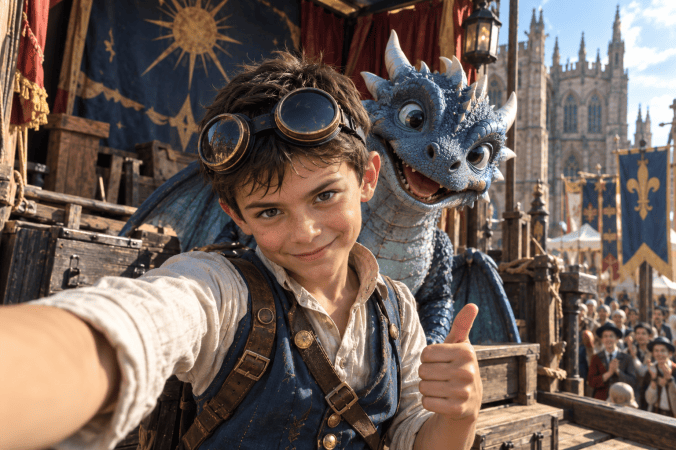
After the show. The theatre may change worlds continuously, but the performers and the audience share one continuing experience. Danil and Blue – concept visualisation by The Disentangler.
PARADE THEATRE
The audience stays. The actors stay. The world moves.
Medieval pageant theatre moved the play from audience to audience.
Parade Theatre moves the world through the play.
Sources & Further Reading
This perspective draws on historical records, modern York Mystery Plays documentation and theatre research concerning medieval pageant wagons and processional performance.
York Mystery Plays – History of the Plays and York Festival Trust
Background on the medieval York Mystery Plays, their craft-guild origins and the modern revival of performances on wagons.
York Mystery Plays — History
History of York – The Mystery Plays
Useful overview of the historical cycle, including its documentation from 1376, the 48 surviving plays, the use of multiple playing stations and the end of the medieval tradition in 1569.
History of York — The Mystery Plays
York Mystery Plays Archive – Wagon Plays
Background on how the plays were traditionally moved from one playing station to another and on the modern revival of wagon performances in York.
York Mystery Plays — Wagon Plays Archive
York Mystery Plays – 2026 Wagon Plays
Documentation of the 2026 production: ten plays performed on wagons travelling through York and stopping at four principal performance locations.
York Mystery Plays — 2026 Wagon Plays
Inventory of the Mercers’ Pageant, 1433 – Company of Merchant Adventurers of York
Transcript of the remarkable surviving inventory for the Mercers’ Last Judgement pageant, including the four-wheeled pageant, painted cloths, clouds, wooden rainbow, angels and machinery associated with Heaven and the raising of Christ.
Read the 1433 Mercers’ Pageant Inventory
Middle English Texts Series – York Corpus Christi Plays
Scholarly discussion of York’s staging evidence and the exceptional importance of the 1433 Mercers’ inventory, including its mechanical theatrical effects.
Middle English Texts Series — York Plays Introduction
Historical Image Sources
David Gee – Representation of a Pageant Vehicle at the time of Performance, 1825
Nineteenth-century reconstruction of a fifteenth-century Coventry pageant performance, created for Thomas Sharp’s study of the Coventry Mystery Plays. The original artwork and its faithful reproduction are Public Domain.
Wikimedia Commons — David Gee pageant engraving
Roger W. Haworth – The Barbers’ Play: The Baptism, York, 2014
Photograph of a modern York Mystery Play performed from a cart in the streets of York. Licensed Creative Commons Attribution-ShareAlike 4.0 (CC BY-SA 4.0).
Wikimedia Commons — The Barbers’ Play: The Baptism
About the Concept Visualisations
Historical reconstructions and Parade Theatre concept images on this page are interpretive visualisations by The Disentangler. Where the precise appearance or configuration of a historical pageant wagon is unknown, the images are intended to explore historically documented elements and theatrical principles rather than claim an exact archaeological reconstruction.
 The Disentangler